Guangzhou, China
Import and Export Commodity Trading Exhibition Hall Zone B
Date: November 18-20, 2026


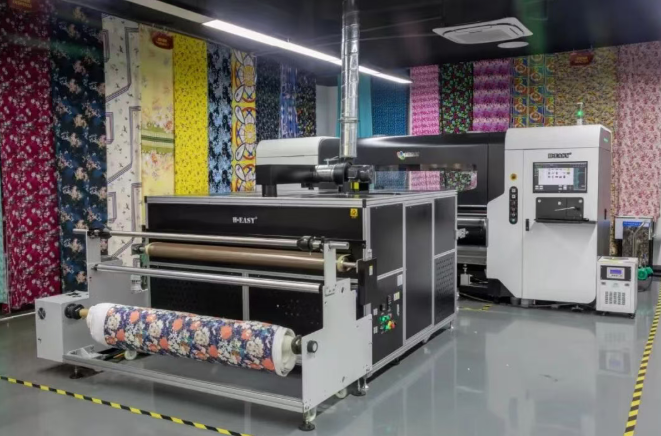
According to the latest "2026 Global Digital Textile Printing Market Report" released by Mordor Intelligence, the global digital textile printing market is expected to reach $3.04 billion by 2026, steadily growing from $2.85 billion in 2025 to $4.23 billion by 2031, with a predicted compound annual growth rate of 6.78%.
01.Analysis of Market Driving Factors
The report analysis points out that there are multiple driving factors behind market growth:
The demand for personalized micro series has exploded
The brand is launching a weekly updated capsule series, eliminating the minimum order quantity requirement, and obtaining higher profits through customized clothing.Kornit DigitalThe Apollo platform enables companies such as T-Formation to launch designs that cater to changing consumer tastes on the same day. On demand printing players meet the surge in demand for customized clothing by integrating production capacity (such as the 2024 Printful/Printify merger). The lower inventory risk, higher price point, and significantly shortened design to shelf life have jointly driven the capacity increase of the digital textile printing market.
Single channel inkjet technology achieves productivity leap
A single channel printer can print the entire image in one go, which is 10-20 times faster than traditional multi-channel systems.Delta GroupThe third installation of EFI Nozomi 14000 SD demonstrates that brand manufacturers are replacing analog production lines with digital production lines to shorten delivery cycles. The Tiger600-1800TS launched by Mimaki for Middle Eastern users in February 2025 also has similar improvements in thermal sublimation printing efficiency. Machine learning driven calibration ensures color consistency on an industrial scale.
E-commerce expansion drives on-demand printing
The rapid development of online retail platforms and customized printing services has made consumers increasingly inclined to purchase personalized and customized textiles through digital channels. The on-demand printing mode eliminates inventory risks while meeting consumers' demand for unique products.
Environmental compliance pressure accelerates transformation
The compliance requirements of the European Union and California have accelerated the shift towards low water pigment solutions. Compared with traditional printing, digital printing can reduce water consumption by more than 90%, and this environmental advantage is becoming an important consideration for brand manufacturers when choosing production processes.
02.Market segmentation and regional pattern
From the perspective of printing methods,Roll to roll systemBy 2025, it will occupy 64.92% of the market share, thanks to its compatibility in mass production of ready to wear clothing, soft labels, and home textiles. At the same time, the single channel production line has become the fastest-growing segment market with a compound annual growth rate of 10.22%, introducing industrial grade throughput into small batch orders, allowing brand owners to merge sampling and large-scale production into one production line.
From the perspective of ink types, dispersed ink will occupy 41.88% of the market share in 2025, which is determined by the dominant position of polyester materials. However,dye sublimation inkBecoming the fastest-growing segment with a compound annual growth rate of 9.12%, as sportswear, promotional flags, and backlit displays pursue bright and long-lasting colors.
From a regional perspective, the Asia Pacific region will control 42.10% of global shipments by 2025, relying on China and India. China has a yarn and fabric export value of 77.9 billion US dollars, while India provides 2.2 billion US dollars in incentive policies through seven PM MITRA parks. The Middle East and Africa region is expected to record the highest compound annual growth rate of 10.75% by 2031, with the United Arab Emirates and Saudi Arabia using free zone incentives to attract investment.
Article content source: Fashion printing
Contact Us
- Address:Room 904, Greenland Center, Financial City, No. 662 Huangpu Avenue Middle, Tianhe District, Guangzhou City
- Phone:020-89300178/89300188
- Email:gzboya@vip.163.com
email subscription
- Click to subscribe to email now (industry news, exhibitor updates, etc.)
- submit
- I want to visit | Be an exhibitor | Cloud exhibition | Events
Follow us